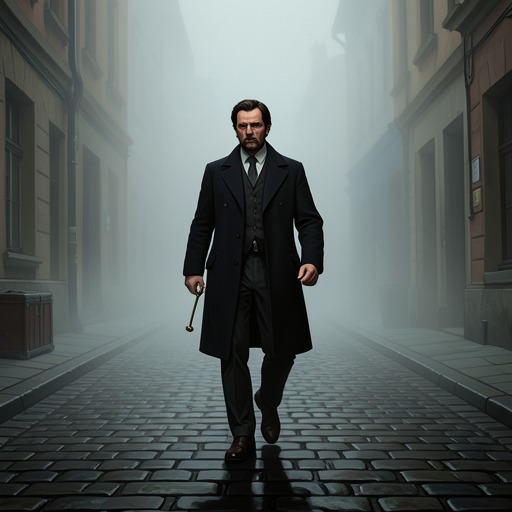
"there are too many ivy here"
The Seven Dials Mystery“A lot too much ivy about this place” is Superintendent Battle’s understated phrase for a feature of the house that first sounds like an eccentric observation and later becomes a clue to movement through its rooms. The ivy matters not simply as part of the setting: Battle identifies it as a route used by the intruder, linking a casual remark at Chimneys to the concealed movements behind the attempted theft at Wyvern Abbey.
The First Observation
Battle makes the remark to Sir Oswald Coote while qualifying what he knows against what he merely thinks. He says that speculation is not worth discussing until it has got somewhere, then points out ivy on Sir Oswald’s coat and calls attention to how much of it surrounds the place. His conclusion is brief: “It complicates things.” The words are deliberately nonspecific. At this point, Battle does not explain what the ivy complicates, and Sir Oswald is interrupted by Rupert Bateman before he can press him further.
The exchange gives an ordinary detail the shape of a withheld deduction. Battle notices the ivy closely enough to pick a piece from Sir Oswald’s coat, but he does not yet disclose the theory that gives the observation its force. His restraint is part of the phrase’s effect: the reader is given a concrete feature and an assurance that it matters, but not the full solution. The ivy is neither announced as a clue in formal terms nor dismissed as decoration; the remark holds those possibilities open while Battle continues to investigate.
Ivy as a Route
Later, when George Lomax rejects the suggestion that the suspect could have reached a room from outside, Battle answers, “Up the ivy again.” The word “again” makes the climbing route a repeated possibility, not an improvised explanation. Battle argues that the man had done it once and could do it twice. The house’s exterior therefore belongs to the mechanics of the mystery: the ivy offers a way to reach a room that a locked door might otherwise make inaccessible.
Battle sets out the route through the connected rooms as well as the climb. He explains that the first approach to Terence O’Rourke’s room was through Sir Stanley Digby’s room, and says that Lady Eileen Brent saw O’Rourke’s doorknob move when the intruder was there the first time. Battle suspects the key was beneath O’Rourke’s pillow. For the later exit, he proposes that the intruder went through the communicating door and Sir Stanley’s empty room while the others had hurried downstairs to the library. The remark about ivy thus opens onto a larger spatial reconstruction: access depends on both the outside wall and the arrangement of adjoining rooms.
The Attempted Theft Reconstructed
Battle’s explanation of the Wyvern Abbey operation supplies the phrase’s most specific meaning. He reasons that Jimmy Thesiger, after the lights were turned out, was so still that Countess Radzky thought he might have left the room. If he had gone outside, Battle asks in effect through his reconstruction, where could he have gone next? His answer is up the ivy to Terence O’Rourke’s room. There, O’Rourke’s whisky and soda had been doped the previous night, and Thesiger could obtain the papers before returning down the same exterior route.
The descent is part of a staged scene rather than a simple escape. Battle says Thesiger threw the papers down to the girl, climbed back down the ivy, and began the apparent fight. The overturned tables, unsteady movement, changes between his ordinary voice and a hoarse half-whisper, and two gunshots were all made to suggest an attack. Battle further explains that Thesiger fired his Colt automatic at an imaginary assailant, then used his left gloved hand to shoot himself through the fleshy part of his right arm with a small Mauser pistol. He threw the pistol through the window, pulled off the glove with his teeth, and put it in the fire before Battle found him apparently unconscious. In this account, the ivy is the discreet connection between obtaining the papers and manufacturing the evidence of an assault.
A Clue Disclosed in Stages
The phrase changes in significance as Battle’s explanation fills in what his first remark leaves unsaid. At Chimneys, “too much ivy” registers as a guarded observation about the premises; later, “Up the ivy again” states the route directly; finally, the account of Thesiger’s climb explains how that route served the theft and its cover story. The wording does not itself reveal the culprit or the full scheme. Its importance comes from recurrence and from the eventual fit between the observation and the reconstructed movements.
That progression also captures Battle’s investigative method in miniature. He separates what he knows from what he thinks, keeps an incomplete inference to himself, and returns to a physical detail when the route of entry becomes decisive. The ivy’s apparent excess is, in retrospect, a practical complication for anyone assuming that locked doors define the limits of access. As a recurring clue, it turns the house’s exterior into part of the puzzle and makes a seemingly incidental remark legible only after the concealed route has been exposed.